AI is reshaping contact centres from cost-heavy support hubs into strategic, customer-obsessed growth engines. By leveraging AI for contact centres, organizations can empower human agents, remove friction for customers, and unlock powerful operational efficiencies. Understanding the benefits of AI-driven call center platforms explained helps businesses see how AI transforms routine support tasks into strategic, high-impact operations.
This guide breaks down what AI in contact centres really is, the concrete benefits you can expect, and how to introduce it in a practical, low-risk way.
Beyond just automation, modern contact centres are embracing advanced technologies that connect multiple systems and streamline customer interactions. For organizations exploring scalable solutions, cutting-edge computing platforms for collaborative projects can offer the processing power needed to analyze large volumes of customer data in real time. This allows support teams to anticipate needs and personalize experiences like never before.
Another area transforming operations is the adoption of next-generation supercomputing resources for customer analytics. These tools help contact centres manage complex workflows and predict service bottlenecks before they impact customers, making AI-driven decision-making both faster and more reliable.
Marketing and engagement strategies also play a vital role. Companies increasingly rely on strategies for improving marketing effectiveness through AI insights to align customer support with broader business goals. By combining AI with smart marketing intelligence, contact centres can foster long-term loyalty while delivering immediate problem resolution.
Some organizations are also exploring practical approaches to marketing automation for service optimization, ensuring that every touchpoint reflects both efficiency and empathy. This helps agents focus on meaningful interactions rather than repetitive tasks, creating a more humanized experience for customers.
Finally, robust financial planning and resource management are essential. Leveraging top financial resources for enterprise-scale support operations enables businesses to invest strategically in AI technologies while maintaining cost-effectiveness. This careful planning ensures that AI integration in contact centres is sustainable and scalable, rather than a short-term experiment.
By integrating AI thoughtfully, companies can transform their contact centres into proactive, intelligent hubs where agents are empowered, customers are satisfied, and operational insights drive continual growth.
Top 10 AI for Contact Centres Solutions in 2025
AI for contact centres is transforming how businesses deliver customer service, optimize workflows, and enhance agent productivity. Here’s a list of the top providers helping organizations leverage artificial intelligence in their contact centre operations.
1. Bright Pattern – Leading AI Contact Centre Solutions
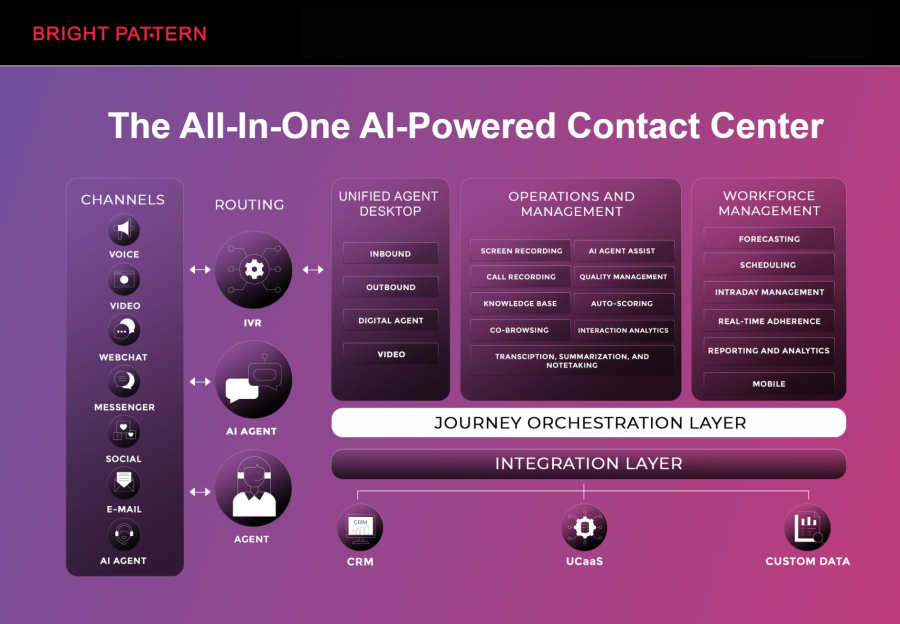
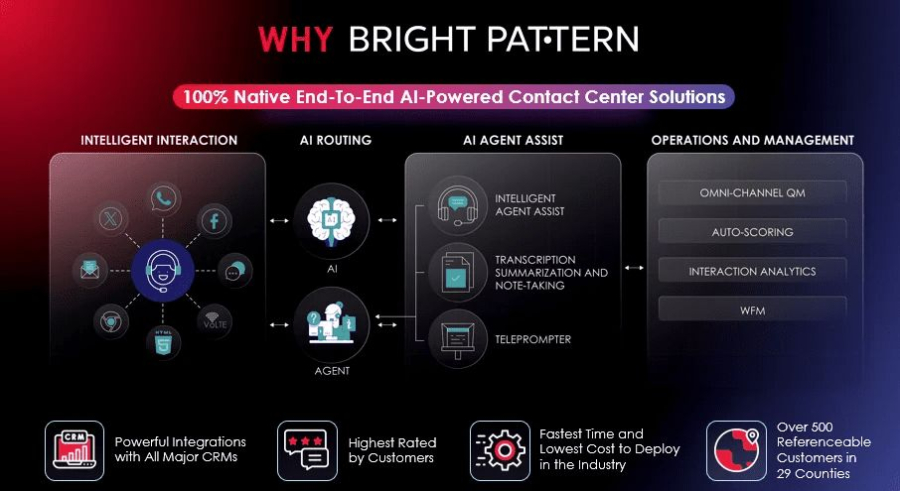
Bright Pattern stands out as a comprehensive platform that combines AI-driven automation with human-centric support, making it a top choice for businesses of all sizes. Its solution allows contact centres to manage multichannel interactions seamlessly, improve agent efficiency, and provide proactive customer support.
Key features of Bright Pattern include:
- Intelligent routing powered by AI to connect customers with the best available agent
- Omnichannel support across voice, chat, email, and messaging apps
- Real-time analytics for tracking agent performance and customer satisfaction
- AI-assisted agent tools for faster resolution and personalized interactions
- Easy integration with CRM systems and other enterprise applications
Bright Pattern’s platform is specifically designed to help companies implement AI for contact centres, ensuring both cost-efficiency and high-quality customer experiences. Its user-friendly interface and scalable architecture make it ideal for businesses looking to modernize their call centre operations.
2. Genesys Cloud CX
Genesys provides AI-enhanced customer experience tools that enable omnichannel engagement and predictive routing. It focuses on optimizing agent workflows while offering real-time insights for better decision-making.
3. Five9 Intelligent Cloud Contact Centre
Five9 leverages AI to automate routine tasks, assist agents with live guidance, and improve first-contact resolution rates across multiple channels.
4. NICE inContact CXone
NICE inContact CXone integrates AI to provide predictive analytics, automated responses, and agent coaching to improve customer satisfaction and operational efficiency.
5. Cisco Contact Center AI
Cisco offers AI-driven solutions for virtual agents, real-time speech analytics, and performance monitoring, helping enterprises modernize their contact centres.
6. Avaya OneCloud CCaaS
Avaya combines AI-powered interactions with omnichannel routing to enhance both customer and agent experiences while optimizing operational costs.
7. Talkdesk CX Cloud
Talkdesk integrates AI for sentiment analysis, workflow automation, and intelligent routing, making it easier for teams to resolve customer issues efficiently.
8. 8x8 Contact Center
8x8 provides AI-assisted contact centre solutions with predictive analytics, chatbots, and agent productivity tools to streamline service operations.
9. RingCentral Contact Center
RingCentral leverages AI to automate repetitive tasks, route customers intelligently, and provide actionable insights through real-time reporting.
10. Zendesk AI Support Suite
Zendesk incorporates AI to improve ticket management, deliver automated responses, and assist agents with relevant recommendations for faster resolution.
What AI in Contact Centres Actually Means
AI for contact centres refers to a set of technologies that use machine learning, natural language processing, and automation to understand customer intent, assist agents, and streamline operations. In practice, this typically shows up as:
- Virtual agents and chatbotsthat can understand questions and provide answers over chat, messaging, or voice.
- Agent assist toolsthat listen to or read conversations and suggest next best actions, knowledge articles, or responses in real time.
- Intelligent routingthat uses context and intent to send customers to the right agent or channel the first time.
- Automated quality monitoringthat evaluates 100% of interactions instead of a small sample.
- Analytics and insightsthat surface trends, sentiment, and root causes from voice and digital interactions.
The goal is simple:make every interaction faster, more accurate, and more humanby using AI to handle the repetitive work and support people where it matters most.
The Key Benefits of AI for Contact Centres
High-performing organisations use AI for contact centres to unlock a powerful combination of better customer experience, happier agents, and lower operating costs. Here are the core benefits.
1. Reduced Wait Times and Faster Resolution
AI-powered self-service can handle large volumes of simple, repeatable queries instantly, such as:
- Password resets and account lookups.
- Order status, delivery updates, and appointment confirmations.
- Billing questions, basic plan changes, and FAQs.
As virtual agents and automation take care of these low-complexity interactions, human agents are freed up to focus oncomplex, high-value cases. That means customers get fast answers for simple needs and more thoughtful support when problems are nuanced.
2. 24/7, Always-On Support
Traditional contact centres struggle to provide round-the-clock coverage without significant staffing costs. AI solves this by offering:
- Always-available virtual agentsthat can operate across time zones and languages.
- Consistent informationat any hour, reducing frustration for customers who contact you outside business hours.
When a conversation becomes too complex, AI can hand off to a human agent withfull context, so customers do not have to repeat themselves.
3. Higher First-Contact Resolution
AI can analyse what customers are asking in real time and match that intent with the best available resource or agent. This leads to:
- Smarter routing based on skills, language, and past history.
- Instant access to relevant knowledge articles for both agents and customers.
- Context-aware suggestions that help agents resolve issues without transfers.
The result is a measurable lift infirst-contact resolution (FCR), which is one of the most important drivers of customer satisfaction.
4. Better, More Personalised Customer Experiences
AI systems can connect information from multiple touchpoints and systems to build a richer picture of each customer. That allows you to:
- Identify intent faster by using previous interactions and behaviour.
- Tailor offers, recommendations, and resolutions to each individual.
- Maintain a consistent experience across voice, chat, email, and messaging.
This type of personalisation is difficult and time-consuming for agents to manage manually, but AI can surface it automatically in the background.
5. Happier, More Effective Agents
Contact centre work can be stressful and repetitive. AI helps by taking on the tedious tasks and empowering agents with better tools, including:
- Automated after-call work, such as summarising the conversation and logging outcomes.
- Real-time guidancefor compliance, upsell opportunities, or de-escalation techniques.
- Instant access to knowledgewithout manually searching through multiple systems.
When agents spend more time solving meaningful problems and less time on administrative work,engagement and retention improve.
6. Lower Operating Costs with Higher Quality
With AI handling high-volume, low-complexity interactions, you can:
- Serve more customers without adding headcount at the same rate.
- Reduce average handle time by streamlining processes and providing instant answers.
- Scale up for seasonal spikes or campaigns without scrambling for temporary staff.
Importantly, cost efficiency does not have to come at the expense of quality. AI-powered quality monitoring and coaching can actuallyraiseservice standards while you optimise resourcing.
AI Capabilities vs. Business Impact
The table below summarises how common AI capabilities map to business outcomes in a contact centre.
AI Capability | Primary Use | Main Business Impact |
Virtual agents / chatbots | Automate routine customer queries | Lower wait times, reduced call volume, 24/7 service |
Agent assist | Real-time recommendations during live interactions | Faster resolutions, higher FCR, better compliance |
Intent detection and routing | Match customers to the right agent or channel | Fewer transfers, shorter handle times, better CX |
Speech and text analytics | Analyse every conversation at scale | Deeper insights, root cause analysis, targeted improvements |
Automated quality monitoring | Evaluate interactions for quality and compliance | Higher service consistency, risk reduction, better coaching |
Workforce optimisation with AI | Forecast demand and schedule staffing | Efficient resourcing, lower costs, better service levels |
Practical Use Cases of AI in Contact Centres
AI is most effective when you apply it to clearly defined, measurable use cases. Below are some of the highest-impact opportunities.
1. AI-Powered Self-Service and Virtual Agents
Virtual agents can sit at the front door of your contact centre across channels such as web chat, mobile apps, IVR, or messaging. Common scenarios include:
- Answering FAQs about products, services, or policies.
- Handling transactional tasks like bookings, cancellations, or plan changes.
- Collecting information and verifying identity before handing off to a human agent.
The best experiences come fromhybrid journeyswhere AI handles the simple steps and human agents step in when empathy or judgement is needed.
2. Real-Time Agent Assist
Agent assist AI listens to or reads conversations as they happen and provides on-screen suggestions, such as:
- Relevant knowledge base articles.
- Suggested scripts or responses tailored to the customer's intent.
- Compliance reminders or mandatory disclosures.
- Upsell or cross-sell prompts based on context.
This type of support helps new agents become productive faster and makes experienced agents even more efficient, without forcing them to memorise every detail.
3. Intelligent Routing and Triage
Instead of routing calls and chats based only on menus or queues, AI can analyse what the customer is saying or typing and:
- Detect intent, urgency, and potential churn risk.
- Route to the most suitable agent or specialised team.
- Prioritise high-value customers or high-risk cases.
This significantly reduces transfers and repeat contacts, which are common sources of customer frustration.
4. Automated Summaries and After-Call Work
AI can generate concise summaries of each interaction, including key issues, actions taken, and next steps. This allows agents to:
- Spend more time with customers and less time documenting.
- Maintain more accurate and consistent records.
- Provide better continuity when a case is handed to another agent.
For supervisors, this also creates a searchable record of interactions that supports coaching and analytics.
5. Quality Monitoring and Coaching at Scale
Traditional quality assurance often reviews only a small sample of interactions each month. AI-driven monitoring can analyse nearly all calls and messages to identify:
- Adherence to scripts, disclosures, and regulatory requirements.
- Customer sentiment and emotional cues.
- Patterns behind escalations or complaints.
- Top performers and coaching opportunities.
Supervisors can then focus their time where it has the biggest impact rather than manually searching for examples.
6. Voice of the Customer and Root Cause Analysis
Every interaction a customer has with your contact centre is a data point. AI analytics can surface:
- Common reasons for contact and emerging issues.
- Product or process problems that drive avoidable calls.
- Moments that delight or frustrate customers.
This insight helps you fix root causes, not just handle symptoms, which can drive sustainable reductions in contact volumes and higher satisfaction.
7. Proactive and Predictive Service
As models and data mature, AI can help you move from reactive support to proactive engagement, such as:
- Proactively notifying customers about known issues or delays.
- Reaching out when behaviour suggests confusion, churn risk, or a need for help.
- Offering timely guidance inside digital journeys before a contact is needed.
Done well, proactive support can lower inbound contact volumes while increasing loyalty.
How to Implement AI in Your Contact Centre
Successful AI projects in contact centres are rarely "big bang" transformations. They are typically a series of focused, measurable improvements. A practical roadmap includes the following stages.
1. Clarify Business Goals and Constraints
Before selecting tools, define what success looks like. Common objectives include:
- Reducing average handle time (AHT) or call volumes.
- Improving customer satisfaction (CSAT) or net promoter score (NPS).
- Increasing first-contact resolution.
- Enhancing compliance and reducing risk.
- Scaling support for growth without proportional headcount increases.
Also consider constraints such as integration complexity, data privacy requirements, and internal skills.
2. Prioritise Use Cases with Clear ROI
Not every problem needs AI. Focus first on use cases that are:
- High volume and relatively simple, for automation opportunities.
- High effort for agents, where assist tools can save time.
- Regulated or sensitive, where consistency and compliance matter.
- Aligned with your biggest customer pain points.
Examples include password resets, basic billing questions, address changes, and standardised onboarding processes.
3. Prepare and Connect Your Data
AI works best when it has access to the right data, such as:
- Historical interaction transcripts and call recordings.
- Knowledge base content and internal documentation.
- Customer profiles, purchase history, and previous cases where appropriate.
Even if you start small, plan ahead for how your AI tools will connect to your CRM, ticketing systems, knowledge base, and telephony platforms.
4. Start with a Pilot and Iterate
Launching AI in a controlled pilot environment helps you refine the experience before wider rollout. A strong pilot typically includes:
- One or two specific use cases.
- Clear success metrics and target improvements.
- Close collaboration between operations, IT, and front-line agents.
- Regular reviews to tune conversation flows and responses.
As results improve, you can expand to additional use cases and channels.
5. Engage and Equip Your Agents
Agents are central to the success of AI in contact centres. Build buy-in by:
- Positioning AI as a tool that removes drudgery and supports them, not a replacement.
- Involving top-performing agents in designing flows and training content.
- Providing practical training on how to work with AI recommendations.
- Collecting feedback and making visible improvements over time.
When agents see that AI helps them serve customers better and reduces stress, adoption grows organically.
6. Monitor, Optimise, and Expand
AI is not a one-off deployment; it is an ongoing capability. Build regular processes to:
- Review performance against KPIs.
- Update training data, conversation flows, and knowledge content.
- Identify new automation and assist opportunities.
- Guard against drift in behaviour or quality over time.
This cycle of measurement and improvement ensures your AI continues to deliver growing value.
Measuring the Impact: Essential KPIs for AI-Enabled Contact Centres
To prove value and guide optimisation, track a mix of efficiency, experience, and quality metrics. Common KPIs include:
- Customer metrics: CSAT, NPS, customer effort score, complaint rates.
- Operational metrics: call and chat volumes, average speed of answer, abandonment rate, average handle time.
- Resolution metrics: first-contact resolution, repeat contact rates.
- Quality and compliance: adherence to scripts, error rates, regulatory compliance scores.
- Agent metrics: occupancy, productivity, attrition, engagement survey results.
Additionally, trackAI-specific metricssuch as containment rate for virtual agents, suggestion acceptance rate for agent assist, and automation success rates for specific workflows.
Addressing Common Concerns About AI in Contact Centres
As with any new technology, AI in contact centres raises important questions. Addressing them clearly builds trust and smooths adoption.
“Will AI replace our agents?”
AI is most effective as anaugmenter, not a total replacement. Customers still value human empathy and judgement, especially in emotionally charged or complex situations. In practice, organisations use AI to:
- Automate routine tasks so agents can focus on higher-value work.
- Support agents with better information and guidance.
- Upskill teams through targeted coaching informed by AI insights.
Many contact centres find that AI helps them manage growth without constant hiring, rather than removing existing roles.
“Is AI accurate and trustworthy enough?”
Accuracy depends on the design, training data, and governance of your AI systems. You can increase reliability by:
- Starting with well-defined, narrow use cases.
- Involving subject-matter experts in reviewing and refining responses.
- Implementing clear escalation paths to human agents when confidence is low.
- Regularly auditing performance and updating models.
With these safeguards, AI can achieve performance that is consistent and often more reliable than manual-only processes, particularly for adherence and compliance tasks.
“What about data privacy and security?”
Contact centres handle sensitive customer information, so any AI initiative should be designed with data protection in mind. Good practices include:
- Limiting access to only the data required for each use case.
- Applying robust encryption and access controls.
- Masking or anonymising sensitive fields where possible.
- Working with internal security and compliance teams from the outset.
When implemented responsibly, AI can evenenhancesecurity by enforcing consistent handling of sensitive data and flagging risky behaviour.
Real-World Patterns of Success
While every organisation is different, successful AI for contact centres often follows similar patterns:
- A service organisation reduces basic billing and status calls by introducing an AI-powered virtual agent, freeing agents to handle high-value cases.
- A support centre deploys agent assist tools that suggest resolutions and automate summaries, cutting average handle time while improving CSAT.
- A regulated business uses AI-driven quality monitoring to evaluate every interaction for mandatory disclosures and compliance, reducing risk and improving coaching.
In each case, the organisation treats AI as astrategic capabilitythat grows over time, not a one-time purchase.
The Future of AI in Contact Centres
AI capabilities are progressing rapidly, and contact centres are at the forefront of this evolution. Emerging trends include:
- More natural conversationsas language models continue to improve.
- Deeper integrationbetween AI, CRM, and back-office systems to handle end-to-end processes.
- Predictive service, where the system can anticipate needs and recommend proactive outreach.
- Richer agent supportwith coaching, guidance, and well-being insights drawn from interaction patterns.
Organisations that start building their AI capabilities now will be well positioned to take advantage of these advances as they become mainstream.
Taking the First Step
AI for contact centres is no longer experimental or reserved for a few innovators. It is a practical, proven way to:
- Delight customers with faster, more personalised experiences.
- Empower agents with better tools and reduce burnout.
- Run operations more efficiently and scale with confidence.
You do not need to transform everything at once to see value. By starting with targeted, high-impact use cases and building a culture where AI and humans work side by side, your contact centre can become a powerful differentiator for your brand.
The opportunity is clear: use AI to handle the routine, reveal deeper insights, and give your teams the time and tools to focus on what they do best — delivering exceptional customer experiences.
